Why Are Screw-Removal Pliers Different? Inside Japan’s ENGINEER Neji-Saurus GT
How does the ENGINEER Neji-Saurus GT PZ-58 grip stripped screws? A look at the Japanese screw-removal pliers, their vertical grooves, uses, and limits.
This article contains affiliate links. Japan Living Edit may earn a commission from qualifying purchases at no additional cost to you.
A damaged screw changes the problem before it changes the tool.
A screwdriver normally depends on engagement with the drive recess in the screw head. The tip fits into the cross, slot, hex, or other drive shape, and torque is transferred through that internal geometry.
When the recess is badly damaged, that relationship can fail. The driver may no longer have enough shape to engage cleanly. Pressing harder can make the recess worse. Changing screwdrivers may help in some cases, but the fundamental issue remains: the usual contact point has stopped being reliable.
The ENGINEER Neji-Saurus GT PZ-58 approaches the problem from another direction. Instead of relying on the damaged recess, it is designed to grip the outside of an exposed screw head.
That is the central idea of this article:
A small change in tool geometry can turn a general-purpose tool into a solution for a specific failure mode.
This is not a hands-on review, a ranking, or a claim that the PZ-58 solves every stripped screw problem. It is a fact-based editorial guide to how the tool’s geometry relates to damaged screw removal, and where its limits begin.
1. Why a Stripped Screw Changes the Problem
A normal screw-driving operation assumes that the screw head still has a usable drive recess.
That recess gives the tool a shaped place to sit. When the screwdriver or bit turns, the shape of the recess resists rotation and lets the screw move.
Once the recess is rounded, crushed, rusted, or otherwise damaged, the problem is no longer simply “turn the screw.” The first problem becomes engagement.
If the driver cannot engage the recess, the screw may remain in place even when the user applies force. The tool can slip, the recess can become more damaged, and the repair can turn into a removal problem rather than a fastening problem.
That distinction matters because it explains why screw-removal pliers exist.
The PZ-58 is not just a regular pair of pliers with a more dramatic name. ENGINEER describes it as pliers that can grab crushed or rusted screws and turn them. The point is to create a second route into the problem: grip the outside of the screw head when the inside is no longer dependable.
This only works when enough of the screw head is exposed for a tool to hold. A flush or recessed screw may require another method. But for an exposed damaged screw head, the outside of the head becomes the remaining available geometry.
2. The Small Design Change: Vertical Grooves
The defining feature of the PZ-58 is at the tip.
ENGINEER states that the tool can grab crushed or rusted screws with the vertical groove at the tip and turn them. The official PZ-58 page lists the compatible screw-head diameter as φ3 to 9.5 mm, and lists the vertical-groove hardness as HRC60 ±2.
The important editorial point is not the hardness value by itself.
It is the direction of the grip.
General pliers are useful for many holding, bending, and pulling tasks, but their gripping surfaces are not necessarily arranged around the specific shape and motion of a screw head. The PZ-58 uses screw-oriented vertical grooves at the tip so the tool can bite into the outside of an exposed screw head and turn it.
That is a small design change with a clear job.
It does not make the tool universal. It does not mean the PZ-58 is stronger than every other method or that it should replace all screw extractors. It means the tool is shaped around one failure mode: a screw head that can no longer be driven normally but can still be gripped from the outside.
3. Why Gripping the Outside of the Screw Matters
The outside of a screw head is not usually the primary interface.
Most screws are designed to be driven through the recess or socket. A screwdriver, bit, or hex key engages that internal form. The surrounding edge of the screw head is not the first place the user expects to work.
But once the recess is damaged, the outside edge may be the remaining usable part.
ENGINEER’s PZ-58 design turns that exposed edge into the working surface. The tool’s tip is meant to approach the screw head from the outside, grip it, and allow the user to turn.
This changes the logic of the repair.
The task is no longer to find a driver that still fits the damaged recess. It is to create controlled contact with another part of the screw head.
That is why geometry matters. The tool has to fit around the head, engage it, and allow turning without being presented as a guaranteed removal method. The official specification gives a screw-head diameter range of φ3 to 9.5 mm, which should be read as an exact-product compatibility range, not as permission to use the tool on every damaged fastener.
The PZ-58 also has a tip width of 17.5 mm and a tip length of 28 mm. Those dimensions help define the physical tool, but they do not decide whether a particular screw in a particular location can be removed. Access, screw exposure, corrosion, adhesive, material hardness, and the surrounding object all still matter.
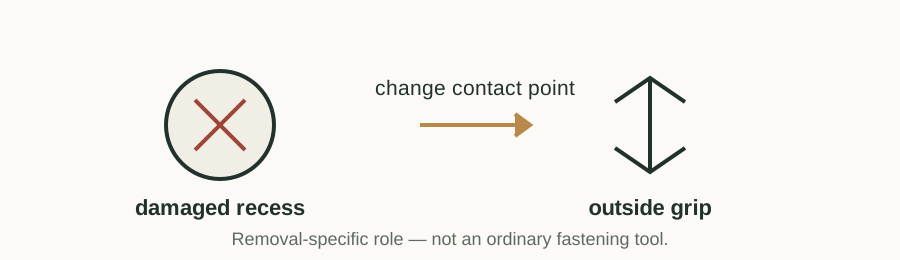
Damaged Screw: Change the Contact Point
Editorial diagram — not a product photograph.
4. From Professional Repair to the Home Toolbox
ENGINEER lists repair, maintenance, disassembly, automotive, motorcycle, bicycle maintenance, and DIY among the PZ-58’s use contexts.
That range is useful, but it should be interpreted carefully.
The point is not that a professional tool automatically becomes better for every homeowner. Professional and home users can simply encounter the same underlying damaged-fastener problem.
A rusted screw on a bicycle accessory, a damaged screw in household hardware, or a fastener encountered during careful disassembly can create a similar kind of failure: the normal drive recess no longer does enough work.
That is where a screw-removal pliers belongs conceptually.
It is not a status object for the toolbox. It is a response to a specific task. If a household repair never involves exposed damaged screws, the PZ-58 may be unnecessary. If damaged screws appear often enough in furniture, hardware, bicycle maintenance, small repair work, or DIY projects, the design becomes easier to understand.
This is similar to the editorial logic in our guide to KAI 7250 Professional Fabric Shears. A professional tool becomes interesting for home use only when the home task shares the same underlying problem the tool was built to address. That same task-first approach is useful when arranging a flexible repair zone rather than leaving every tool on one permanent bench.
5. The PZ-58 Is Still a Pair of Pliers
Specialized geometry does not remove the need to read the tool as a pair of pliers.
The PZ-58 has a total length of 160 mm and a listed weight of 130 g. ENGINEER lists the body material as carbon steel and the grip material as elastomer. The official specification also lists a blade length of 8 mm, a grip width of 54 mm, and cutting capacity for soft iron wire of φ2.6 mm and solid copper wire of φ3.2 mm.
Those details identify the object.
They should not be inflated into broad claims about durability, comfort, or overall quality. Japan Living Edit is not evaluating the grip by hand, cutting wire with the tool, or testing the PZ-58 against other screw-removal methods.
The safer reading is straightforward:
ENGINEER built a pliers-form tool whose tip geometry is aimed at damaged screw heads.
That means the user still has to think like someone using pliers. The screw head needs to be exposed enough to grip. The tool needs room to approach the screw. The surrounding material needs to allow the jaw position. The exact fastener and situation still matter.
Purpose-built does not mean situation-proof.
6. What It Cannot Do
The most important part of a screw-removal article may be the limitations.
ENGINEER warns not to use the PZ-58 with high-hardness screws such as tapping screws, drilling screws, or coarse-thread construction screws where the manufacturer prohibits that use. The manufacturer also cautions that screws completely stuck because of rust or adhesive may not be removable.
Those limitations are not small print. They are central to understanding the tool honestly.
The PZ-58 should not be presented as a universal screw extractor. It does not remove any stripped screw. It does not guarantee removal. It does not replace every other screw-extraction method.
The design is tied to a particular condition:
an exposed screw head that can be gripped from the outside and falls within the tool’s intended use.
If the screw is flush, fully recessed, too hard for the permitted use, completely seized, bonded by adhesive, or located where the pliers cannot reach, the method may not apply.
That is not a weakness in the editorial sense.
It is the boundary that makes the product intelligible.
7. A Japanese Tool Built Around a Very Specific Failure
The PZ-58 is made in Japan, and the exact product identity is tied to ENGINEER Inc., Neji-Saurus GT, model PZ-58, JAN 4989833039585.
That origin is useful context, but it is not the reason the tool is interesting.
The stronger design story is more specific: ENGINEER translated a damaged-fastener problem into the geometry of the tool itself. Instead of asking the same damaged recess to keep doing the same job, the PZ-58 shifts attention to the outside of the screw head.
That is a narrow and practical design move.
It does not support claims about Japanese products being inherently better, Japanese manufacturing proving durability, or Japanese craftsmanship as a universal explanation. The article’s focus is not national character. It is problem-solving geometry.
For Japan Living Edit, that is exactly where everyday object design becomes worth studying.
The object is small. The failure mode is ordinary. The design response is concrete.
8. Who the PZ-58 Makes Sense For
The PZ-58 may be worth considering for someone who regularly encounters exposed damaged screws in repair, maintenance, disassembly, bicycle work, automotive or motorcycle contexts, furniture hardware, or DIY projects.
It may be less relevant for someone who rarely repairs things, mostly encounters recessed screws, needs a different extraction method, or cannot safely apply pliers to the surrounding object.
The decision should start with the screw problem, not the product name.
Ask:
- Is the screw head exposed enough to grip?
- Is the head diameter within the stated φ3 to 9.5 mm range?
- Is the screw type allowed under ENGINEER’s current cautions?
- Is the screw completely seized by rust or adhesive?
- Is there enough space for a 160 mm pliers-form tool to approach and turn?
- Would another method be more appropriate for this specific fastener?
Those questions keep the tool in its proper role.
It is not a magic object for the toolbox. It is a purpose-shaped answer to one common repair failure.
9. Viewing the ENGINEER Neji-Saurus GT PZ-58
The exact model discussed in this article is the ENGINEER Neji-Saurus GT PZ-58, JAN 4989833039585.

View the ENGINEER Neji-Saurus GT PZ-58 on Amazon (paid link)
The Amazon and Rakuten affiliate links are purchase routes, not sources for product mechanism, specifications, limitations, or editorial interpretation.
Before buying, confirm the listing, seller, shipping terms, model number, ASIN, and whether PZ-58 matches the screw-removal problem you actually need to solve.
Final Thoughts
Screw-removal pliers are easiest to understand when the failure comes first.
A screwdriver depends on engagement with the drive recess. When that recess is badly damaged, the normal interface can stop working. The ENGINEER Neji-Saurus GT PZ-58 responds by shifting the grip to the outside of an exposed screw head, using screw-oriented vertical grooves at the tip.
That is the practical design lesson.
The PZ-58 is not interesting because it invites large claims. It is interesting because its geometry is so specific.
Start with the damaged screw. Then decide whether the tool’s exact method, range, access requirements, and cautions fit the repair in front of you.