Why Does a Soldering Iron Need a Station? Inside the HAKKO FX-888DX
Understand the HAKKO FX-888DX temperature-controlled soldering station, Japan 100V specifications, handpiece and holder, and the FX888DX-81BY full set.
This article contains affiliate links. Japan Living Edit may earn a commission from qualifying purchases at no additional cost to you.
A soldering iron can look like the whole tool because it is the part that touches the work.
But a temperature-controlled soldering station changes the object around that hot tip. The station adds an interface, a display, a holder, interchangeable working parts, and a service ecosystem around the handpiece itself.
That makes the HAKKO FX-888DX useful to study as a Japanese professional tool that can also make sense in some home electronics contexts.
The central question is simple:
Why does a soldering iron need a station?
This is not a hands-on review, a beginner recommendation, or a claim that a professional tool automatically improves results. It is a fact-based editorial guide to how the FX-888DX organizes heat control, holding, replaceable parts, safety scope, and repair support around a soldering handpiece.
1. From Hot Tool to Controlled Workstation
A basic soldering iron can be understood as a heated hand tool.
Plug it in, let it heat, solder, and put it somewhere safe between touches. The tool may still be useful, but much of the workflow lives outside the object itself.
A soldering station brings more of that workflow into one system.
The station gives the user a place to set temperature. The display makes the setting visible. The separate handpiece connects to the station output. The holder gives the hot tool a defined return point. Tips can be changed for different contact shapes, and replacement parts or repair service may extend beyond the initial purchase.
That is the editorial thesis of this article:
A soldering station adds control and support around the heating tool itself.
The point is not status. It is architecture.
2. Temperature Setting and Interface
HAKKO identifies the rotary encoder as a key interface feature of the FX-888DX.
In the Japan-spec product line, the FX888DX-81BY, FX888DX-81SV, and FX888DX-81YW full sets are listed at ¥27,500 tax included. HAKKO Japan lists power consumption at 100 W and a temperature range of 50-480℃.
The station specifications list output as AC 26 V, dimensions as 100 W x 120 H x 125 D mm, and station weight as 1.2 kg. HAKKO Japan also lists temperature stability as ±1℃ at idle when set between 200-480℃.
Those numbers should be read as product specifications, not as a promise that every soldering task becomes simple.
Temperature control is a system feature. It can help define the workflow, but soldering results still depend on materials, technique, surface preparation, tip condition, solder, flux, and the task itself.
3. The Iron, Holder, and Tip System
The Japan full sets include the FX-8801 soldering iron with a T18-B tip and an iron holder with cleaning sponge and cleaning wire.
HAKKO Japan lists the FX-8801 handpiece at 65 W at 26 V, with a ceramic heater, 1.2 m cord length, total length of 217 mm with T18-B, and weight of 46 g with T18-B. The same Japan specification table lists tip-to-ground resistance as less than 2 Ω and tip-to-ground potential as less than 2 mV.
The important design idea is separation.
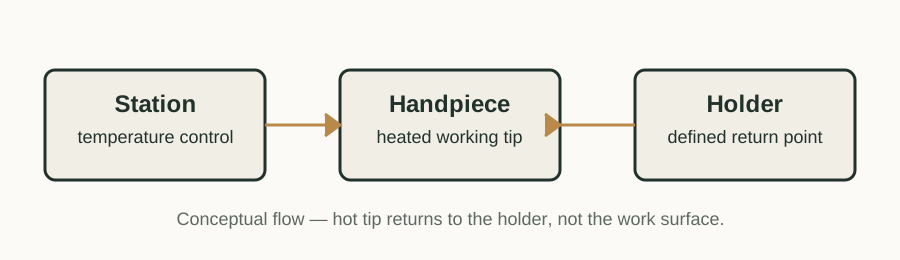
The station, handpiece, holder, and tip are not one solid object. They form a small bench system: the station controls, the handpiece heats, the holder receives the hot tool between actions, and the tip is the replaceable working contact.
For the storage boundary after the work is complete, see our guide to storing cutting and hot tools safely in a small home.
The diagram is conceptual. It is not an electrical schematic or a product rendering. Its purpose is to show why the station matters: the handpiece is only one part of the working system.
Station, Handpiece, and Holder
Editorial diagram — not a product photograph.
4. ESD SAFE, Precisely Scoped
HAKKO Japan marks the FX-888DX as ESD SAFE.
The official explanation is specific. HAKKO treats products as ESD SAFE countermeasure products when they are grounded and show a charging voltage of 50 V or less under the specified MIL-STD-3010A test method.
That scope matters.
ESD SAFE should not be simplified into a universal electronics-safety guarantee. It does not mean a product cannot damage any component in any situation. It does not remove the need for appropriate bench practice, component handling, grounding, or manufacturer instructions.
For this article, ESD SAFE is best understood as part of the station’s controlled-workbench identity, not as permission to ignore electrical or static-sensitive handling requirements.
5. Professional Bench to Home Electronics
Soldering stations are easy to associate with professional benches: electronics assembly, PCB work, repair stations, and controlled soldering workflows.
That professional context is relevant, but it should not be turned into a superiority claim.
The more useful bridge is task similarity. A home maker, keyboard builder, RC hobbyist, cable-repair tinkerer, or retro-hardware repairer may encounter the same need for controlled heat, a safe holder, appropriate tips, and replaceable working parts.
HAKKO USA’s FX-888DX page mentions DIY contexts including jewelry, RC cars, phones, tablets, and other projects. Those examples show that HAKKO presents the station beyond industrial use.
This does not mean every home needs a station. It means some home projects share enough bench logic with professional repair to make the architecture understandable. For a broader, task-first way to arrange that kind of work in a small home, see our guide to a small home repair bench.
For another Japan Living Edit example of a professional tool crossing into home repair logic, see our article on ENGINEER Neji-Saurus GT screw-removal pliers.
6. Japan vs US Market Specifications
Specifications and included parts vary by market. This article uses HAKKO Japan specifications for the Japan set and notes US-market differences separately.
That distinction is important because HAKKO Japan and HAKKO USA do not present every detail identically.
For the Japan full sets, HAKKO lists FX888DX-81BY, FX888DX-81SV, and FX888DX-81YW. The Japan page lists a 50-480℃ temperature range, includes the FX-8801 handpiece, and identifies the included standard tip as T18-B.
HAKKO USA currently lists the FX-888DX at $121.47 and in stock. Its US product information lists a 50-450℃ range, and identifies the included handpiece as FX8801-02 with standard tip T18-D16.
That is exactly why region-specific caution matters.
Do not combine a Japan temperature range, US included tip, and another market’s part number into one hybrid specification. When buying or comparing, use the official page for the exact market and set being considered.
7. Repair, Warranty, and Replaceable Parts
HAKKO Japan marks the FX-888DX as repairable and shows replacement parts and compatible options on the official product page.
The same product page describes a manufacturer three-year warranty service. The stated condition is that user and product registration are required.
That warranty information should be read narrowly. It is not a lifetime support promise, and it does not prove an unusually long product lifespan.
The repair and parts ecosystem matters for a different reason:
Serviceability is part of the tool ecosystem.
The FX-888DX is not only a box with a handpiece. It is presented with tips, a holder, cleaning parts, handpieces, replacement parts, documentation, and repair support. That makes maintenance part of the station concept.
8. Safety Belongs in the System Too
Soldering tips operate at high temperature.
That may sound obvious, but it is central to why the holder and work area matter. A station gives the hot handpiece a defined place to return, but the user still has to follow HAKKO instructions and appropriate safety practices.
Keep the work area clear. Use an appropriate holder. Use ventilation appropriate to the soldering materials and process. Disconnect power before applicable maintenance. Avoid mains-voltage repair unless appropriately qualified.
This article is not a soldering tutorial, and it does not provide hazardous electrical repair instructions.
The design point is narrower: a soldering station organizes the hot tool within a defined work setting, but it does not replace training, instructions, or good judgment.
9. What This Design Does Not Prove
The FX-888DX should not be treated as proof that professional tools are automatically right for every home.
This article does not claim unusual soldering outcomes, speed advantages, universal precision, automatic professional results, exceptional durability, or suitability for every repair task.
It also does not compare the FX-888DX against every competing station.
The supported facts are narrower: HAKKO’s official Japan and US pages describe the station interface, set contents, temperature ranges, handpiece details, ESD SAFE scope, warranty terms, repair status, and replacement ecosystem.
That is enough for an editorial design guide.
It lets us examine why a soldering station exists without turning the article into a ranking or a shopping verdict.
10. Who This Station May Suit
The FX-888DX may be relevant to readers who do enough electronics, repair, hobby, or maker work to benefit from a station-based soldering setup.
That might include PCB repair, keyboard projects, cable repair, RC work, retro hardware repair, or small electronics projects where controlled temperature, a holder, interchangeable tips, and replaceable parts are meaningful.
It may be less relevant for a reader who rarely solders, only needs a tool for one simple task, or does not have a safe work area.
The practical question is not “Is this professional?”
It is:
Does your soldering workflow need more than a hot hand tool?
Viewing the Japan-spec FX888DX-81BY
The exact Japan-spec model linked here is the HAKKO FX888DX-81BY, the blue and yellow full set. The Amazon link is a purchase route, not a source for product specifications, limitations, or editorial judgments.

View the HAKKO FX-888DX-81BY on Amazon Japan (paid link)
Before buying, confirm the model number, seller, shipping terms, and Japan 100V specification for your intended use.
Final Thoughts
A soldering station changes the object around the soldering iron.
The handpiece still matters. The tip still touches the work. Heat is still central.
But the station adds structure: temperature setting, display, holder, tips, replacement parts, warranty terms, repair support, and market-specific configurations.
That is why the HAKKO FX-888DX is useful to study.
It shows how a tool can become a small workstation, with control and support arranged around the heating tool itself.