Why Does Tightening a Bolt Need a Target Torque? Inside the KTC GW050-03
Understand the KTC GW050-03 9.5 sq. preset torque wrench: its 10–50 N·m range, target-torque lock, calibration needs, and clockwise-only limit.
This article contains affiliate links. Japan Living Edit may earn a commission from qualifying purchases at no additional cost to you.
Tightening a bolt can feel like a simple hand action.
Turn the tool. Feel resistance increase. Stop when the fastener seems tight enough.
But “tight enough” is not a specification.
In many assemblies, the important question is not whether the bolt feels tight. It is whether the tightening process reaches the target torque specified for that exact assembly by the equipment or component manufacturer.
The KTC GW050-03 is useful to study because it turns tightening from an open-ended hand action into a measurable target-and-stop workflow. It does not choose the correct torque by itself, and it does not guarantee correct assembly. It gives the user a tool for working toward a specified torque value when the task, socket setup, direction, and tool condition are appropriate.
This is not a vehicle repair guide, a bicycle repair tutorial, or a list of bolt torque values. It is a fact-based editorial guide to how a preset torque wrench changes the tightening workflow, and where that control begins and ends.
1. Why “Tight Enough” Is Not a Specification
A hand tool can tell the user many things through resistance.
The fastener begins to seat. The material stops moving as easily. The handle feels harder to turn.
Those signals are useful, but they are not the same as a target torque.
Torque is a rotational force value. KTC’s torque-wrench guidance explains torque wrench selection by first checking the work content, function, and measurement range. That sequence matters because the wrench is not the source of the target value. The assembly is.
For a wheel, machine component, bicycle part, appliance, or other fastened assembly, the correct value must come from the relevant manufacturer service documentation or exact component specification. If that information is missing, the torque wrench does not solve the uncertainty.
That is the central editorial question:
Why does tightening a bolt need a target torque instead of “tight enough”?
Because the design problem is not only turning the fastener. It is deciding when to stop.
2. What Torque Adds to Tightening
Without a specified target, tightening can depend heavily on feel.
That does not mean every feel-based fastening task is wrong. It means the stopping point is less explicitly defined.
With a specified target and a suitable torque wrench, the task gains a measurable stopping condition. The user identifies the required torque from the equipment or component documentation, sets the wrench, locks the setting, tightens in the appropriate direction, and stops when the target indication is reached.
This is a workflow change, not a guarantee of perfection.
Torque is one controlled variable in a larger assembly process. Thread condition, lubrication, part condition, user technique, socket fit, tool range, measurement direction, and calibration state can all matter.
3. The GW050-03 Exact Specification
The exact product covered here is the KTC GW050-03, a 9.5 sq. preset torque wrench in KTC’s GW010-03 to GW100-03 series.
KTC’s current official product page lists the GW050-03 with:
- torque measurement range: 10-50 N·m
- minimum scale: 0.25 N·m
- L1: 374.9 mm
- L2: 298.6 mm
- weight: 0.6 kg
- measurement direction: right / clockwise only
- torque accuracy: ±3%
- current official Japan reference retail price: ¥24,200 before tax
That price should be read as a current official reference price, not as a permanent or global price.
The model identity is important. GW050-03 should not be merged with GW050-03T, GW025-03, GW100-03, CMPC0503, TGW050103, digital torque wrenches, or generic torque-wrench sets.
This article also does not claim a verified manufacturing country for the GW050-03. KTC is a Japanese manufacturer, but a Japanese manufacturer is not the same as verified manufacturing origin for a specific SKU.
The 10–50 N·m Boundary
Editorial diagram — not a product photograph.
4. Setting a Target Before Applying Force
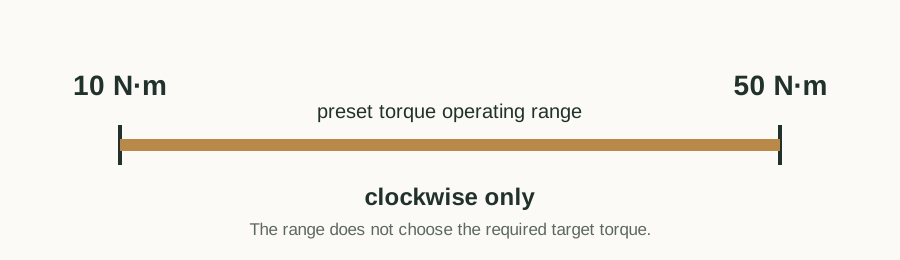
The 10-50 N·m range is the wrench’s measurement and setting range.
It is not a recommendation to tighten any bolt somewhere within that range.
The correct target value comes from the equipment manufacturer, service documentation, or exact component specification. If the specified torque does not fall within the tool’s range, the GW050-03 is not the right measuring tool for that task.
This distinction is easy to miss because a range looks like guidance.
It is not.
The wrench is suitable only where the specified torque falls within 10-50 N·m, the exact drive and socket setup is appropriate, the task permits clockwise torque measurement, and the tool is in suitable condition.
That makes the torque wrench part of a documentation-led workflow:
Find the required value first. Choose and set the tool second.
For another Japan Living Edit article about measurement tools and why specification context matters, see our guide to the Mitutoyo CD-15AX ABS Digimatic Caliper.
5. The Lock Mechanism
Preset torque is useful only if the setting remains intentional during the job.
KTC states that the GW series uses a lock mechanism intended to prevent unintended changes to the torque setting. That makes the workflow more structured:
Set the target. Verify the scale. Lock the setting. Tighten.
This should not be exaggerated into a foolproof claim. A lock mechanism does not remove the need to set the correct value, read the scale carefully, use the tool correctly, or confirm that the task itself is appropriate.
It does, however, show how the tool is designed around more than leverage.
The wrench is organizing a sequence of decisions before the bolt is tightened.
6. What Happens at the Preset Torque
KTC describes a preset torque wrench as indicating the preset value through a light tactile shock and a click sound when the set torque is reached.
That sentence needs a guardrail.
KTC also notes that depending on the torque setting and individual product variation, the sound may not occur.
So the safe reading is:
Reaching the preset torque can be indicated by a light tactile shock and/or click, while an audible click may not occur in every condition.
The sound itself is not a calibration certificate. Multiple extra clicks are not a goal. Continuing to pull after the target indication can undermine the point of the tool.
The design purpose is to create a stopping condition, not to encourage the user to keep confirming it.
7. Why Calibration Matters
A torque wrench is a hand tool, but it is also a measuring instrument.
That second identity changes how it should be treated.
KTC’s product warnings include a recommendation for periodic torque calibration to maintain measurement accuracy. The official page also warns users to stay within the torque measurement range, avoid extending the wrench with a pipe, avoid hammer use, avoid dropping or strong impacts, and remember that the product is not waterproof.
Those warnings all point in the same direction:
Using a measuring tool outside its intended conditions can undermine the very control the tool is meant to provide.
This article does not specify a calibration interval because the current product information used here does not provide one for this article’s purpose. The broader point is simpler: measurement capability depends on the tool’s condition, not only on the number printed on its scale.
That is why a storage case also has editorial relevance. KTC lists a durable resin storage case for the product. This does not mean the case protects accuracy in all situations, but it supports the idea that a torque wrench benefits from being stored as an instrument rather than treated like an impact tool.
8. Professional Workshop to Home Maintenance
Torque control is common in professional contexts: automotive service, machinery maintenance, controlled assembly, and maintenance work where specified tightening torque matters.
It can also appear in home or maker contexts, including personal vehicle maintenance, bicycle work, DIY equipment, and hobby machinery.
The overlap is not that every home needs a torque wrench.
The overlap is that both professional and home tasks may involve assemblies where “tight enough” is replaced by a specified torque value.
That only applies where the user has the exact documentation, understands the task, uses a suitable tool and socket setup, and works within the tool’s limits. Safety-critical assemblies may require a qualified professional rather than a general editorial article. For a task-based way to decide which work deserves a dedicated surface and which tools should stay stored, see our guide to a small home repair setup.
Different fastening problems can also require different tool logic. For example, our article on the ENGINEER Neji-Saurus GT looks at a damaged-screw problem where the contact point changes from the screw recess to the outside of the head.
9. Right-Direction-Only and Other Limits
The GW050-03’s official specification lists the measurement direction as right / clockwise only.
That matters.
This article treats the official clockwise-only measurement direction as a real limit, not as a minor note.
KTC’s official page also lists ±3% torque accuracy and states that the series clears ISO standards. That should be read narrowly as KTC’s product specification, not as Japan Living Edit independently certifying the tool, not as permanent accuracy without calibration, and not as a claim of superiority over competitors.
The scale design and grip also belong in this narrower category.
KTC states that main and secondary scale visibility is improved for easier torque-setting work. It also describes the elastomer resin grip as resistant to deterioration and designed for fit. Those are manufacturer-described features. They should not be expanded into claims of zero reading errors, injury reduction, fatigue prevention, or ergonomic superiority.
10. What a Torque Wrench Does Not Guarantee
A preset torque wrench does not guarantee correct assembly by itself.
It does not know whether the torque value was copied from the correct manual. It does not know whether a thread is damaged, lubricated, dirty, corroded, or using the right hardware. It does not verify that the socket setup is suitable, that the user has stopped correctly, or that the tool is calibrated.
It also does not make this article a repair instruction.
Japan Living Edit does not provide torque values or tightening procedures for safety-critical assemblies in vehicles, bicycles, machinery, structures, electrical equipment, gas equipment, or similar high-stakes contexts.
For those tasks, use the exact manufacturer service documentation and seek a qualified professional where appropriate.
11. Who This Tool May Suit
The GW050-03 may be relevant where a user needs a 9.5 sq. preset torque wrench for specified clockwise tightening tasks within 10-50 N·m, and where the exact task documentation supports that range.
That sentence is intentionally narrow.
It is not a general recommendation that homeowners should buy a torque wrench. It is not a claim that this model is the right choice for all mid-range fasteners. It is not a substitute for service information or training.
The useful lesson is more structural:
A torque wrench is chosen around the task’s specified target, not around the user’s desire to make tightening feel more precise.
If the value, direction, socket setup, or tool condition is wrong, the workflow loses its meaning.
Buying the Exact Model
The model covered here is the KTC GW050-03, a 9.5 sq. preset torque wrench with a 10–50 N·m range.

View the KTC GW050-03 on Amazon Japan (paid link)
The Amazon link is a purchase route, not a source for product specifications, limitations, or editorial judgments. Before buying, confirm the exact model, seller, shipping terms, and suitability for the intended task, including the required torque range and clockwise-only measurement limit.
12. Final Thoughts
The KTC GW050-03 is interesting because it changes the shape of a familiar action.
Tightening becomes less about deciding by resistance alone and more about following a target-and-stop sequence: find the specified value, set the wrench, lock the setting, tighten in the appropriate direction, and stop at the indication.
That does not make the tool automatic. It does not remove judgment, documentation, calibration, or safety responsibility.
It makes the stopping point explicit.
And in any assembly where the correct stopping point matters, that is the design idea worth studying.